
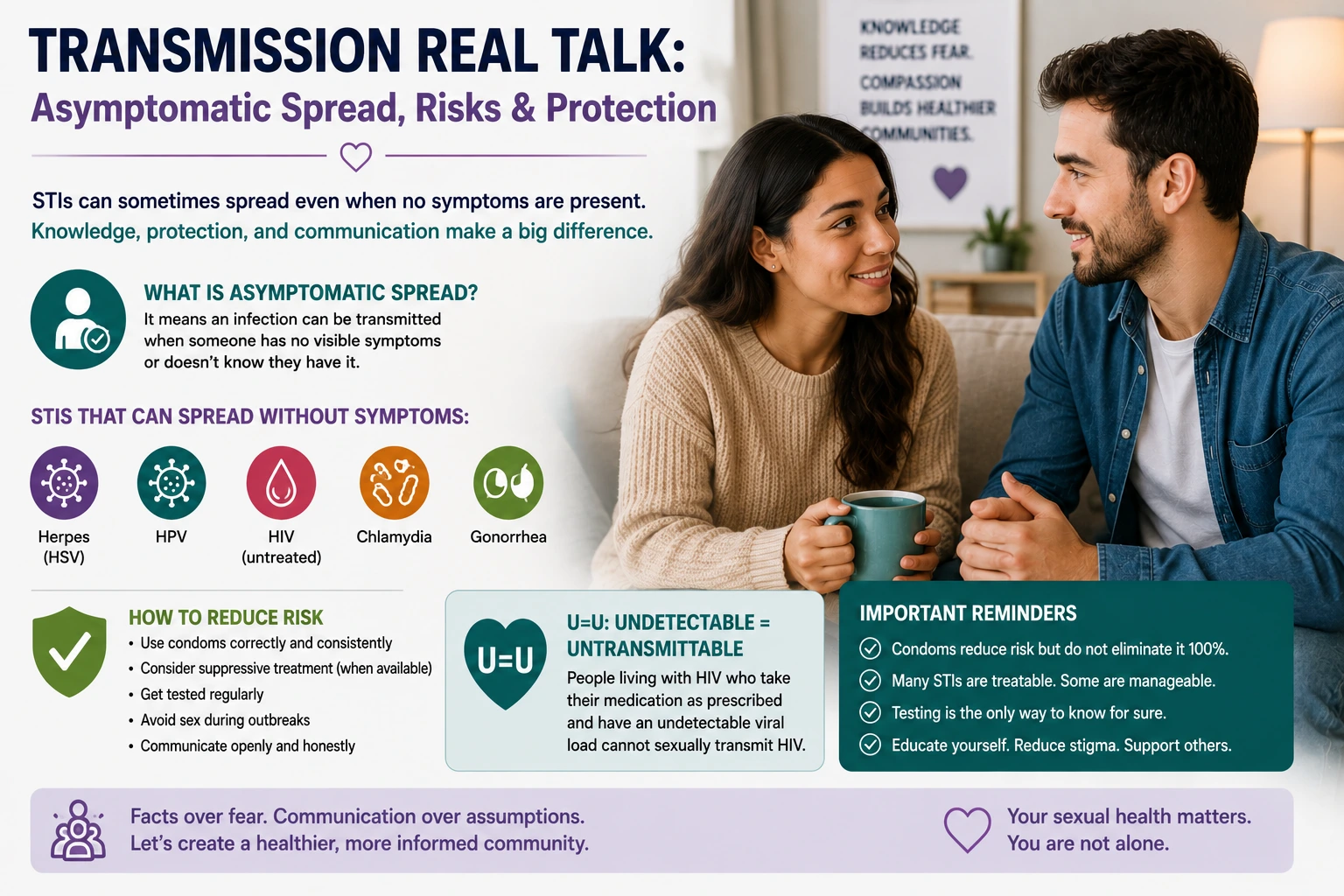
Transmission Real Talk: Asymptomatic Spread, Risks & Protection
Transmission Real Talk: Asymptomatic Spread, Risks & Protection
One of the biggest misconceptions about sexually transmitted infections (STIs) is the belief that transmission only happens when visible symptoms are present.
Many people ask questions like:
- “Can someone spread herpes without an outbreak?”
- “Can HPV spread without symptoms?”
- “If someone looks healthy, are they safe?”
- “Do condoms fully eliminate risk?”
These questions often create fear, confusion, and misinformation—especially because many STIs can spread even when symptoms are not obvious.
This guide explains what asymptomatic transmission means, what affects transmission risk, and how protection and education help reduce fear.
What Is Asymptomatic Transmission?
Asymptomatic transmission means an infection may spread even when someone:
- Has no visible symptoms
- Feels completely healthy
- Does not realize they carry an STI
Many common STIs may sometimes spread asymptomatically, including:
- Herpes (HSV)
- HPV
- HIV (before diagnosis or without treatment)
- Chlamydia
- Gonorrhea
This is one reason why many infections spread unknowingly.
According to the CDC, many sexually transmitted infections can be present without noticeable symptoms, making regular testing and communication important.
Why Symptoms Alone Are Not Reliable
Many people assume they would “know” if they or their partner had an STI.
However, many infections:
- Cause mild symptoms
- Cause no symptoms at all
- Remain dormant for long periods
- Are mistaken for other conditions
This is why relying only on visible symptoms may create false confidence.
For a deeper look at testing limitations, read:
Understanding Herpes Transmission
Herpes is one of the most discussed examples of asymptomatic spread.
HSV transmission may occur:
- During outbreaks
- During asymptomatic viral shedding
- Even when skin appears normal
However, transmission risk may be reduced through:
- Suppressive antiviral therapy
- Condom use
- Avoiding intimacy during outbreaks
- Open communication
Learn more:
- Herpes Dating: How to Talk About HSV-1
- First Herpes Outbreak or Positive Test: What to Expect
- Herpes Disclosure: How, When, and What Real People Wish They Knew
Understanding HPV Transmission
HPV is one of the most common sexually transmitted infections worldwide, and many people who carry HPV have no symptoms.
Because HPV often causes no visible signs, transmission may occur without either person realizing it.
Vaccination, routine screening, and honest communication can help people make informed decisions about their sexual health.
You may also find helpful:
Understanding HIV & U=U
HIV conversations frequently involve major misunderstandings around transmission risk.
Research shows that people living with HIV who maintain an undetectable viral load through treatment cannot sexually transmit HIV.
This is known as U=U:
Undetectable = Untransmittable.
Accurate HIV education has helped dramatically reduce fear and misinformation for many people.
According to the CDC, maintaining an undetectable viral load effectively eliminates the risk of sexual HIV transmission.
Additional resources:
- HIV Disclosure Dating: How to Have the Conversation with Confidence
- Serodiscordant Couples: Building Healthy Relationships with Different HIV Statuses
Can Condoms Eliminate All STI Risk?
Condoms significantly reduce the risk of many STIs, but no prevention method offers 100% protection against every infection.
Risk reduction depends on:
- The type of STI
- Consistent condom use
- Skin-to-skin contact areas
- Viral suppression or treatment
- Communication and awareness
Safer sex focuses on reducing risk—not achieving perfection.
The World Health Organization (WHO) recommends combining protection methods, testing, and communication to reduce STI risks.
Why Fear-Based Messaging Often Backfires
Many online discussions around STI transmission become emotionally driven by panic instead of education.
Fear-based thinking may increase:
- Stigma
- Shame
- Anxiety
- Misinformation
Many people report feeling calmer once they learn accurate information about actual transmission risks.
Related reading:
- My Life Isn't Over: Emotional Coping After an STD Diagnosis
- The Mental Health Impact of STI Testing Stigma
Communication Matters More Than Assumptions
Healthy sexual relationships often involve:
- Honest conversations
- Testing awareness
- Discussing protection
- Mutual consent
- Emotional maturity
Open communication frequently reduces fear more effectively than silence or assumptions.
If disclosure feels intimidating, these guides may help:
- How to Tell Someone You Have an STD Without Fear
- How to Tell Someone You Have an STD: A Dating Guide
Education Helps Reduce Stigma
Many people living with STIs say learning accurate medical information helped them emotionally recover from fear-based stigma.
Understanding:
- Actual transmission risks
- Protective options
- Treatment advances
- U=U
- How common STIs actually are
often helps replace panic with perspective.
Meet Positives supports informed, respectful, and emotionally safe conversations around sexual health and safer intimacy through its:
FAQ
Can STIs spread without symptoms?
Yes. Many STIs may spread even when someone has no visible symptoms.
Can herpes spread without an outbreak?
Yes. HSV may spread during asymptomatic viral shedding even when skin appears normal.
What does U=U mean?
U=U means Undetectable = Untransmittable for people living with HIV who maintain an undetectable viral load.
Do condoms eliminate all STI risk?
Condoms significantly reduce risk, but no prevention method guarantees 100% protection against every STI.
Why is STI education important?
Accurate education helps reduce fear, stigma, misinformation, and anxiety surrounding sexual health.
Medical Disclaimer
This article is for educational and informational purposes only and should not be considered medical advice. Always consult qualified healthcare professionals regarding STI testing, diagnosis, treatment, transmission risks, or sexual health concerns.
Bottom Line
Many STIs may spread without visible symptoms, which is why education, communication, testing awareness, and safer sex practices matter.
Accurate information often reduces fear far more effectively than stigma, panic, or misinformation.
Join the Meet Positives Community
Looking for a supportive community where sexual health conversations happen without judgment? Meet Positives helps people connect, learn, and build meaningful relationships through understanding and honesty.
You can join free, browse our STD Dating community, explore Herpes Dating, HIV Dating, and HPV Dating, visit the Safety Center, read more Sexual Health & Safer Intimacy articles, or learn more on the Meet Positives homepage.
Share This Story, Choose Your Platform!
Current User
Comments (0)
Ask A Question
Have A Question, Personal Story, Or Situation You'd Like Help With? Share It Here. The More Context You Include, The More Thoughtful And Useful Our Guidance Can Be.
Our Editorial Team (And Occasional Relationship Contributors) May Choose Selected Submissions To Answer In An Upcoming Blog Post. All Submissions Are Reviewed And Published Anonymously—We Will Never Include Identifying Details.
Important:
If Your Question Is About Your Account, Billing, Upgrades, Reports, Or Technical Issues, Please Contact Customer Care Through The Help Pages So We Can Assist You Faster.
Tips For A Better Answer (Optional):
- Your Age Range + What You're Looking For (Dating, Friendship, Support)
- What You've Tried So Far
- What You're Hoping Happens Next
- Any Boundaries Or Dealbreakers You Want Respected
Responses Shared Here Are For General Information Only And Aren't Medical, Legal, Or Mental-Health Advice.
We Can't Provide Real-Time Or One-On-One Support Through This Form.