
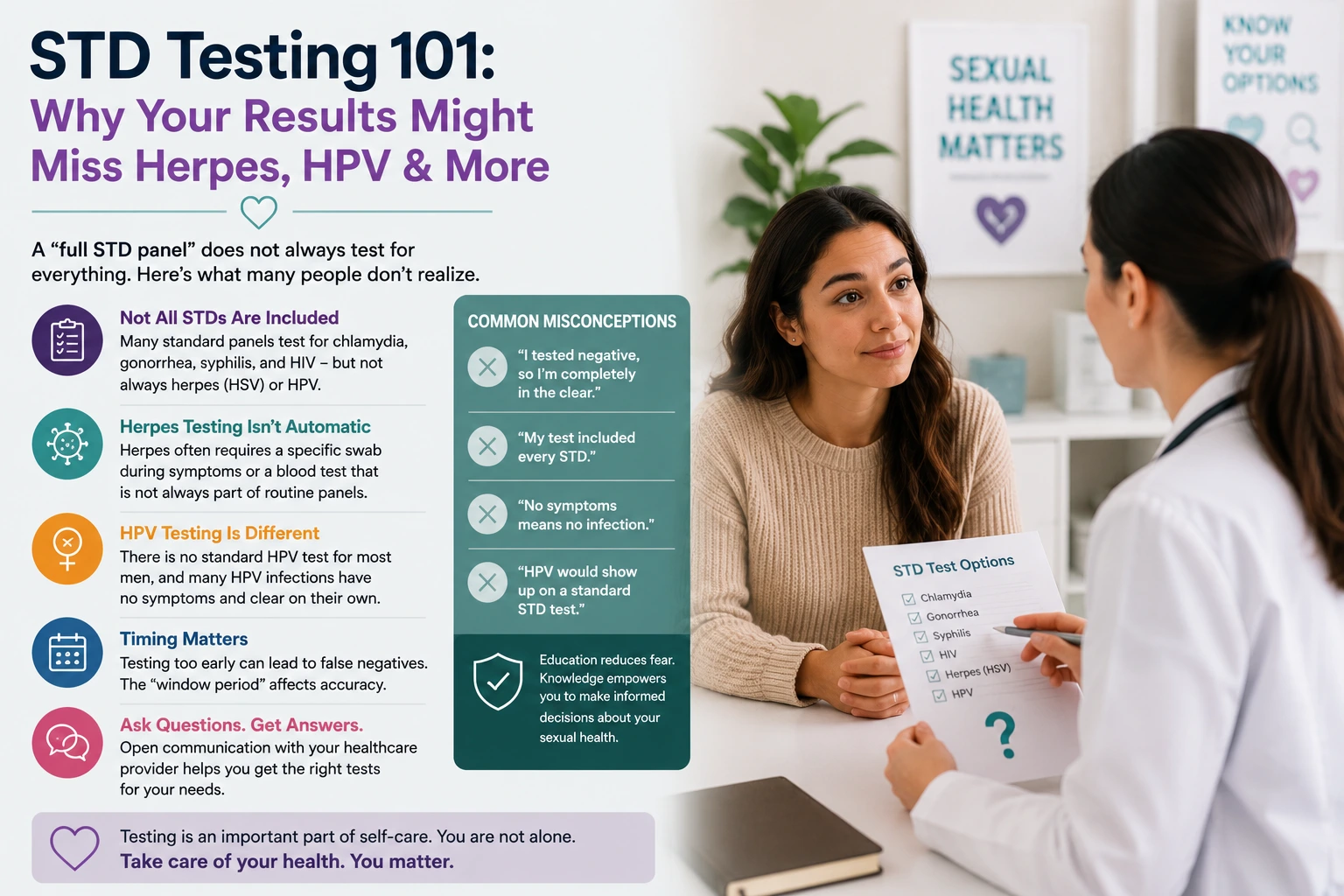
STD Testing 101: Why Your Results Might Miss Herpes, HPV & More
STD Testing 101: Why Your Results Might Miss Herpes, HPV & More
Many people assume that asking for a “full STD panel” means they are automatically being tested for every sexually transmitted infection. However, that is often not the case.
Many people are surprised to learn that standard STI testing may not automatically include herpes (HSV), HPV, or certain other infections.
Common questions include:
- “Why wasn’t herpes included in my STD panel?”
- “Can I still have HPV if my test was normal?”
- “How accurate are herpes blood tests?”
- “Why didn’t my doctor test me for everything?”
Understanding how STI screening works can help reduce confusion, anxiety, and misinformation surrounding sexual health.
What Is Usually Included in a Standard STI Panel?
Standard STI panels vary depending on:
- Your healthcare provider
- Your symptoms
- Your sexual history
- Your location
- Clinic policies
Many routine STI screenings commonly test for:
- Chlamydia
- Gonorrhea
- Syphilis
- HIV
However, herpes and HPV testing are often handled differently.
According to the CDC STI Screening Recommendations, screening recommendations vary based on age, risk factors, symptoms, and sexual activity.
Why Herpes Testing Is Frequently Excluded
Many people are surprised to discover that herpes testing is not always included automatically in standard STI panels.
Reasons may include:
- High rates of asymptomatic HSV
- Concerns about false positives
- Testing limitations
- Guidelines that prioritize symptom-based testing
Herpes testing may involve:
- Swab tests during active outbreaks
- Blood tests detecting HSV antibodies
Many people only learn they have HSV after symptoms appear or after specifically requesting testing.
Learn more in:
- First Herpes Outbreak or Positive Test: What to Expect
- Herpes Disclosure: How, When, and What Real People Wish They Knew
Why HPV Testing Can Feel Confusing
HPV testing also causes major confusion for many people.
Some important things many people do not realize:
- There is no standard HPV screening test for most men
- HPV may exist without symptoms
- Many HPV infections clear naturally
- Pap smears and HPV tests are different
Because HPV behaves differently from many other STIs, conversations around testing and disclosure often become emotionally confusing.
The CDC HPV Resource Center explains that HPV is extremely common and that many infections resolve naturally without causing long-term health problems.
You may also find helpful:
False Positives, False Negatives & Timing
STI testing accuracy may depend on:
- Testing method
- Timing after exposure
- Lab quality
- Type of infection
Many people do not realize that testing too early after exposure may affect accuracy.
This is sometimes called the window period, where infections may not yet appear clearly on tests.
Different infections have different testing windows, which is why healthcare providers may recommend repeat testing in certain situations.
Why Communication with Doctors Matters
Many people assume doctors automatically test for “everything,” but healthcare providers often select tests based on:
- Symptoms
- Risk factors
- Guidelines
- Medical history
Asking questions and discussing concerns openly with healthcare professionals may help reduce misunderstandings.
Helpful questions may include:
- Which infections am I being tested for?
- Are herpes or HPV included?
- Should I retest later?
- What do my results actually mean?
Common Emotional Reactions to Unexpected Results
Many people report feeling:
- Confused
- Angry
- Anxious
- Embarrassed
- Overwhelmed
Many people say they wish sexual health education had explained STI testing more clearly earlier in life.
Supportive resources can help reduce fear and provide better understanding of both testing and diagnosis.
You may find support in:
Education Reduces Fear
Many people find that learning accurate sexual health information helps reduce:
- Stigma
- Panic
- Misinformation
- Fear around testing
Understanding how STI testing actually works may help people make more informed and emotionally grounded decisions.
Meet Positives supports informed, respectful, and emotionally safe sexual health conversations through its:
FAQ
Does a standard STI panel test for everything?
Not always. Many standard panels commonly test for chlamydia, gonorrhea, syphilis, and HIV, but may not automatically include herpes or HPV.
Why is herpes testing sometimes excluded?
Reasons may include testing limitations, false-positive concerns, and guidelines focused on symptom-based testing.
Can someone still have HPV without symptoms?
Yes. Many people with HPV never experience symptoms.
What is a testing window period?
A window period is the time after exposure when infections may not yet appear accurately on tests.
Can STI tests ever be inaccurate?
Testing accuracy can vary depending on timing, test type, and other medical factors.
Medical Disclaimer
This article is for educational and informational purposes only and should not be considered medical advice. Always consult qualified healthcare professionals regarding STI testing, diagnosis, treatment, screening recommendations, or sexual health concerns.
Bottom Line
Many people misunderstand how STI testing actually works. Standard STI panels may not automatically include herpes or HPV testing, which is why asking questions and understanding your screening options matters.
Education, communication, and accurate information can help reduce fear, confusion, and stigma surrounding sexual health testing.
Join the Meet Positives Community
Looking for a supportive environment where sexual health conversations are welcomed without judgment? Meet Positives helps people connect, learn, and build meaningful relationships through education and understanding.
You can join free, browse our STD Dating community, explore Herpes Dating, HIV Dating, and HPV Dating, visit the Safety Center, read more Symptoms & Testing resources, or learn more on the Meet Positives homepage.
Share This Story, Choose Your Platform!
Current User
Comments (0)
Ask A Question
Have A Question, Personal Story, Or Situation You'd Like Help With? Share It Here. The More Context You Include, The More Thoughtful And Useful Our Guidance Can Be.
Our Editorial Team (And Occasional Relationship Contributors) May Choose Selected Submissions To Answer In An Upcoming Blog Post. All Submissions Are Reviewed And Published Anonymously—We Will Never Include Identifying Details.
Important:
If Your Question Is About Your Account, Billing, Upgrades, Reports, Or Technical Issues, Please Contact Customer Care Through The Help Pages So We Can Assist You Faster.
Tips For A Better Answer (Optional):
- Your Age Range + What You're Looking For (Dating, Friendship, Support)
- What You've Tried So Far
- What You're Hoping Happens Next
- Any Boundaries Or Dealbreakers You Want Respected
Responses Shared Here Are For General Information Only And Aren't Medical, Legal, Or Mental-Health Advice.
We Can't Provide Real-Time Or One-On-One Support Through This Form.