
Can Herpes Spread to Your Eyes? Symptoms and When It's an Emergency
The short answer: Yes. Herpes can infect the eye, a condition called ocular herpes. It is usually caused by HSV-1, the cold-sore virus, and most often appears as a flare-up of an infection a person already has. A painful red eye, light sensitivity, blurry vision or watery discharge is a reason to call an eye doctor the same day, because herpes keratitis can scar the cornea and harm vision if it is not treated.
If you already live with HSV-1 or HSV-2, a burning or red eye can feel scary, and online forums are full of guesses. This guide explains how herpes reaches the eye, which symptoms matter, why speed matters, what an eye exam and treatment generally involve, what the research says about daily antivirals, and how to lower the chance of spreading the virus to your eyes. It is based on guidance from the CDC, the National Eye Institute (NEI) and published medical reviews.
Can herpes spread to your eyes?
Yes. The National Eye Institute explains that when a herpes virus (the same type that causes cold sores and genital herpes) infects the eye, it can cause sores on the eyelid or on the outer layer of the cornea, the clear front window of the eye. This is called ocular (eye) herpes. If the infection spreads deeper into the cornea, it can become a serious infection called keratitis, which can cause corneal scarring and vision loss (NEI: Other Types of Corneal Disease).
Eye herpes is not one single condition. NEI describes milder forms that affect the eyelid (blepharitis), the lining of the eye (conjunctivitis) or the surface of the cornea (epithelial keratitis), and a more serious form, stromal keratitis, in which the immune system attacks a deeper layer of the cornea.
How does herpes get into the eye?
According to the CDC's page on HSV keratitis, herpes simplex virus spreads through direct contact, and most herpes eye infections happen after another part of the body, most commonly the mouth, has already been infected. The CDC says HSV keratitis is often the result of a "flare up" (reactivation) of that earlier infection.
In plain terms, there are two main routes:
- Reactivation: After a first infection, herpes stays dormant in nerve cells. A medical review in StatPearls explains that the virus can settle in the nerve that serves the eye and face and later travel back to the cornea when it reactivates. Our guide to how long herpes can stay dormant explains latency in more detail.
- Direct contact: Touching an active sore, or fluid from one, and then touching your eye can carry the virus there. That is why the CDC's first prevention tip is hand washing before touching your eyes.
Eye herpes can also come back. NEI notes that once people develop ocular herpes, they have up to a 50 percent chance of a recurrence, which can come weeks or even years later.
Is eye herpes HSV-1 or HSV-2?
Usually HSV-1. The CDC says HSV-1, the strain that causes cold sores on the mouth, is the primary cause of HSV keratitis. A systematic review in BMJ Clinical Evidence (Barker, 2008) says ocular herpes is usually caused by HSV-1 but occasionally by HSV-2. StatPearls adds that the old rule of "HSV-1 above the waist, HSV-2 below" is no longer clear-cut, because both types can be found in either area.
So if you have genital HSV-2, eye involvement is possible but less typical. If you have HSV-1 in either location, it is the type most often linked to eye infections. Either way, the symptoms and the need for a prompt eye exam are the same. For more on how the two types differ, see our post on oral herpes vs. genital herpes.
What are the symptoms of eye herpes?
The CDC lists these symptoms of HSV keratitis:
- Eye pain
- Eye redness
- Blurred vision
- Sensitivity to light
- Watery discharge (tearing)
NEI adds that ocular herpes can cause sores on the eyelid. StatPearls describes the classic picture as sudden pain, light sensitivity, blurry vision and watery discharge, often in one eye, sometimes with a feeling that something is stuck in the eye. Both eyes can be affected, but it is less common: the BMJ Clinical Evidence review cites a long-term Minnesota study in which 12 percent of people with ocular herpes had it in both eyes.
Why is eye herpes an emergency?
Because the cornea can be permanently damaged. The CDC states that HSV keratitis "can lead to serious eye complications, including scarring of the eye, and blindness when left untreated," and calls it a major cause of blindness worldwide. Many surface infections heal without lasting damage, but deeper or repeated infections can scar the cornea. NEI notes that repeated stromal keratitis can lead to the need for a corneal transplant.
The CDC's advice is direct: if you have these symptoms, remove your contact lenses (if you wear them) and call your eye doctor immediately. StatPearls also stresses that delays in care can lead to worse outcomes. Treat a painful red eye with light sensitivity or blurry vision as a same-day problem, not something to wait out over the weekend.
Who should you see?
An eye doctor, ideally an ophthalmologist (a medical doctor who specializes in eyes). If you cannot get a same-day eye appointment, urgent care or an emergency room can assess you and arrange an urgent ophthalmology referral. Tell them you have a history of herpes. It is useful medical information, and nothing to be ashamed of.
How is eye herpes diagnosed and treated?
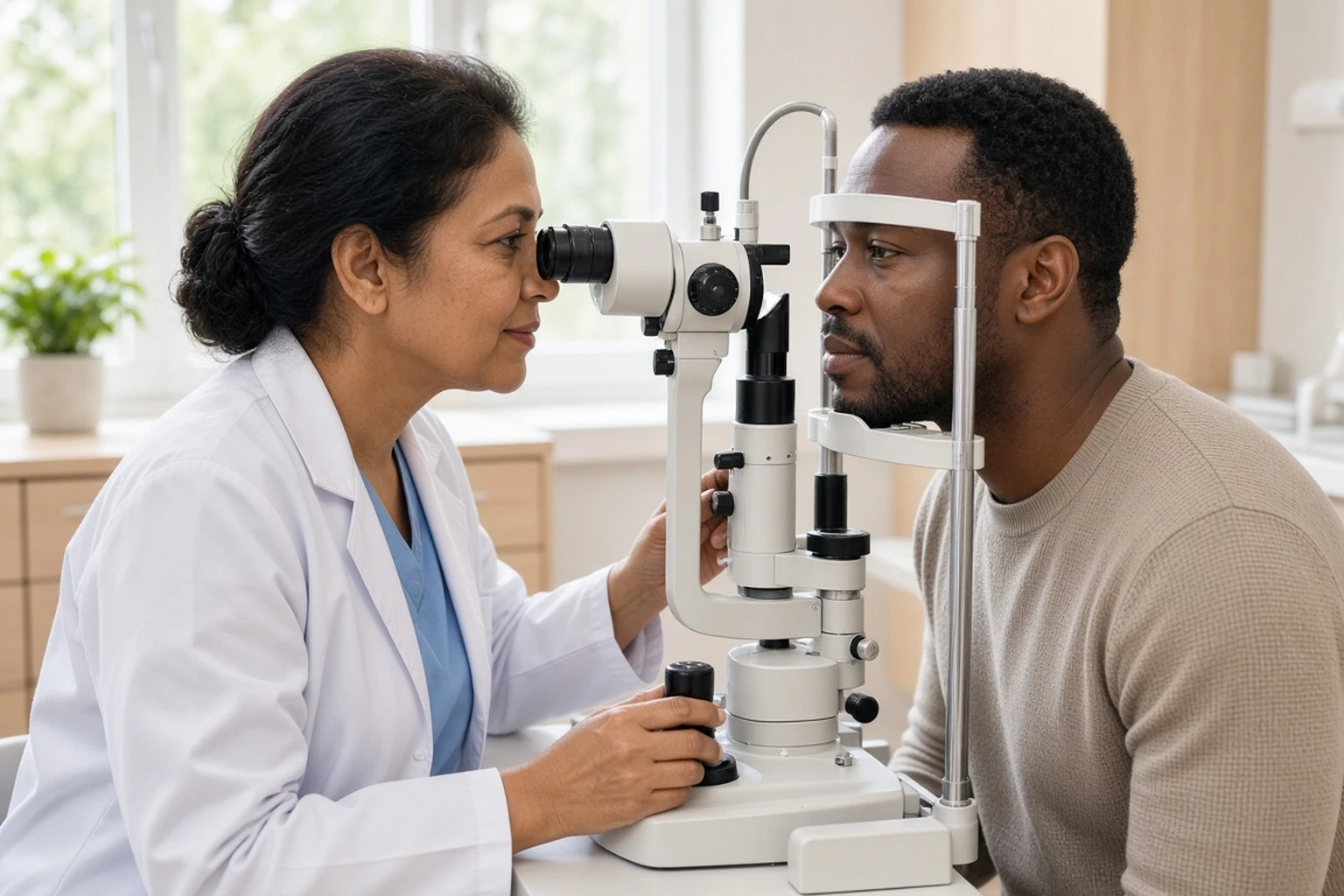
The CDC says HSV keratitis is usually diagnosed based on your health history and an eye exam, and lab testing is not usually necessary. StatPearls explains that the exam uses a slit lamp, a microscope with a bright light that lets the doctor see the layers of the cornea, often with special dye drops. When confirmation is needed, a swab or sample from the eye can be tested by PCR, which can also tell HSV-1 from HSV-2. A herpes blood test cannot diagnose an active eye infection, because it cannot tell past exposure from a current eye infection.
Treatment depends on which part of the eye is involved. The CDC says it usually involves medicine, including eye drops or antiviral medicines taken by mouth, and that surgery is rarely needed unless scarring affects vision. In the CDC's words, "Each case of HSV keratitis is unique, and an eye doctor should determine the best treatment." Your eye doctor chooses the medicine, the dose and how long to use it.
One important caution: the CDC advises using only eye drops prescribed or recommended by an eye doctor or health care provider. StatPearls notes that steroid eye drops can make some forms of herpes keratitis worse, even though doctors sometimes prescribe them carefully for other forms. Do not use leftover drops or someone else's drops on a red eye.
Do daily antivirals prevent eye herpes from coming back?
They can lower the risk, but they do not bring it to zero. The best-known evidence comes from the NEI-funded Herpetic Eye Disease Study. In its Acyclovir Prevention Trial, published in the New England Journal of Medicine in 1998, 703 people who had ocular herpes in the previous year took either oral acyclovir or a placebo for 12 months (NEI study summary):
- Any form of eye herpes returned in 19 percent of the acyclovir group vs. 32 percent of the placebo group, a 41 percent reduction.
- Among 337 people with a history of stromal keratitis, the more serious form, recurrences fell from 28 percent to 14 percent.
- Herpes on the mouth and face also dropped (20 percent vs. 35 percent).
- When treatment stopped, recurrences did not rebound above placebo levels in the following six months.
The study's chair also said that not every patient benefited equally, and that patients should ask their eye care professional whether long-term antiviral use is right for them. StatPearls notes that eye specialists may consider long-term antivirals for people with frequent recurrences or infection in both eyes, and that other oral antivirals are sometimes used as alternatives to acyclovir.
What this means if you already take daily suppressive therapy, as many people with genital or oral herpes do: it may lower your risk, but an eye flare is still possible, and the study drug and schedule may differ from yours. New eye symptoms still need an eye exam. Ongoing burning or discomfort is not always active virus, either. StatPearls notes that people who have had herpes keratitis can develop dry-eye symptoms or nerve-related discomfort, sometimes in both eyes, even when the infection is dormant. Only an eye exam can tell the difference. For background on daily antivirals in general, see our guide to suppressive therapy for herpes.
How can you keep herpes away from your eyes?
- Wash your hands thoroughly before touching your eyes, especially when you have a cold sore or herpes blisters, as the CDC advises.
- Do not touch, pick or rub sores, and avoid rubbing your eyes during an outbreak. StatPearls recommends avoiding hand-to-eye contact as much as possible.
- Contact lens care: Wash your hands before handling lenses and follow your eye doctor's cleaning and replacement instructions. The CDC notes that for people who have had HSV keratitis, wearing contact lenses may further raise the risk of recurrence, so ask your eye doctor whether lenses are still right for you.
- Use only prescribed eye drops, and do not share eye drops or towels during an outbreak.
- Know your triggers. NEI lists fever, stress, sunlight and eye injury among factors believed to be linked to eye herpes recurrences. Our post on how stress triggers herpes outbreaks covers practical ways to manage stress.
Is it eye herpes, shingles or pink eye?
Several conditions can look alike, so the label you guess at home is less important than getting examined.
- Shingles in the eye (herpes zoster): This is a different virus, the chickenpox virus (varicella-zoster virus, or VZV), reactivating in nerve cells, usually years after chickenpox. NEI says that when shingles affects the cornea it can cause swelling and scarring, and anyone with shingles on the face, nose or eyes should get a comprehensive eye exam. Herpes zoster keratitis is one of the conditions eye doctors rule out when they suspect herpes simplex.
- Pink eye (conjunctivitis): Pink eye has many causes, and the CDC lists herpes simplex virus as one of them. CDC pink eye guidance says to see a health care provider if you have pink eye with eye pain, light sensitivity, blurred vision that does not improve when discharge is wiped away, or intense redness. Those are the same warning signs as herpes keratitis. Antibiotic drops do not treat viral pink eye.
- Other causes: StatPearls lists corneal scratches, other corneal infections and contact lens-related problems among the conditions that can look like herpes keratitis.
Living and dating with herpes when your eyes are involved
Having eye herpes does not mean you did something wrong, and it does not make you less deserving of love or intimacy. It means you have a common virus that showed up in a sensitive place, and it deserves prompt care. Most people who get treatment manage it well, and many go long stretches without a flare.
A few things can help. Keep your eye doctor's contact information handy so you can act fast if symptoms return. Tell new clinicians about your herpes history. If you are dating, you can share as much or as little as you choose, when you are ready. Many people mention eye herpes simply as part of their health picture ("I get the occasional eye flare, so if my eye looks red I'll be at the eye doctor"). Disclosure timing and any legal duties differ by state. Our post on whether you can have a normal dating life with herpes offers encouragement and practical tips. When you meet someone new, the usual safety steps still apply: meet in public, tell a friend your plans and move at a pace that feels consensual for both of you.
FAQ
Can I give myself eye herpes by touching a cold sore?
It is possible, which is why the CDC recommends washing your hands before touching your eyes, especially when you have a cold sore or herpes blisters. The CDC also notes that most eye infections are flare-ups of a virus already in your body, not new infections.
Can genital herpes (HSV-2) spread to the eyes?
It can, but it is less common. Medical reviews say ocular herpes is usually HSV-1 and occasionally HSV-2. Hand washing after touching any active sore lowers the risk.
I take daily antivirals. Can I still get eye herpes?
Yes. In the NEI-funded trial, long-term acyclovir cut recurrences but did not eliminate them; 19 percent of people on the drug still had a recurrence within a year. New eye symptoms still need a same-day call to an eye doctor. Do not change your medicine on your own; talk with your prescriber.
Can eye herpes cause blindness?
It can if it is severe or not treated. The CDC says HSV keratitis can lead to corneal scarring and blindness when left untreated, though many infections heal without damaging the eye. Prompt care lowers the risk of lasting harm.
Is eye herpes contagious?
Herpes simplex spreads through direct contact. During an active eye infection, avoid touching your eye, wash your hands often and do not share towels or eye drops. Ask your eye doctor about precautions for your situation.
The bottom line
Herpes can reach the eyes, usually as an HSV-1 flare-up, and it is very treatable when caught early. A painful red eye, light sensitivity, blurry vision or tearing calls for a same-day visit with an eye doctor, not a wait-and-see approach. Long-term antivirals can lower the chance of eye recurrences, and your eye doctor can tell you whether they make sense for you. Living with herpes, including eye herpes, is part of your health, not your worth. If you want a dating community where you don't have to explain the basics, join MeetPositives or visit the MeetPositives homepage.
Sources
- Centers for Disease Control and Prevention. "What Causes HSV (Herpes Simplex Virus) Keratitis." May 27, 2025. https://www.cdc.gov/contact-lenses/causes/what-causes-hsv-herpes-simplex-virus-keratitis.html
- National Eye Institute. "Other Types of Corneal Disease" (ocular herpes; shingles). Last updated Dec. 6, 2024. https://www.nei.nih.gov/eye-health-information/eye-conditions-and-diseases/corneal-conditions/other-types-corneal-disease
- National Eye Institute. "Antiviral Drug Sharply Reduces Return of Herpes of the Eye." July 29, 1998. https://www.nei.nih.gov/research-and-training/research-news/antiviral-drug-sharply-reduces-return-herpes-eye
- Herpetic Eye Disease Study Group. "Acyclovir for the Prevention of Recurrent Herpes Simplex Virus Eye Disease." N Engl J Med. 1998;339:300-306.
- Ahmad B, Gurnani B, Patel BC. "Herpes Simplex Keratitis." StatPearls (NCBI Bookshelf). Updated March 10, 2024.
- Barker NH. "Ocular herpes simplex." BMJ Clin Evid. 2008;2008:0707.
- Centers for Disease Control and Prevention. "Clinical Overview of Pink Eye (Conjunctivitis)" and "How to Treat Pink Eye." April 15, 2024.
This article is for general information only and is not medical or legal advice. It does not create a doctor-patient relationship. Talk with a licensed health care provider about your own situation. Laws vary by state; for legal questions, talk with a licensed attorney.
Share This Story, Choose Your Platform!
About the author
Staff Writer
Comments (0)
Ask A Question
Have A Question, Personal Story, Or Situation You'd Like Help With? Share It Here. The More Context You Include, The More Thoughtful And Useful Our Guidance Can Be.
Our Editorial Team (And Occasional Relationship Contributors) May Choose Selected Submissions To Answer In An Upcoming Blog Post. All Submissions Are Reviewed And Published Anonymously—We Will Never Include Identifying Details.
Important:
If Your Question Is About Your Account, Billing, Upgrades, Reports, Or Technical Issues, Please Contact Customer Care Through The Help Pages So We Can Assist You Faster.
Tips For A Better Answer (Optional):
- Your Age Range + What You're Looking For (Dating, Friendship, Support)
- What You've Tried So Far
- What You're Hoping Happens Next
- Any Boundaries Or Dealbreakers You Want Respected
Responses Shared Here Are For General Information Only And Aren't Medical, Legal, Or Mental-Health Advice.
We Can't Provide Real-Time Or One-On-One Support Through This Form.